What Is an RO Plant?
A Reverse Osmosis Plant is a water treatment system that uses pressure to pass water through a semi-permeable membrane. The membrane allows water molecules to pass while rejecting many dissolved impurities, salts, and contaminants.
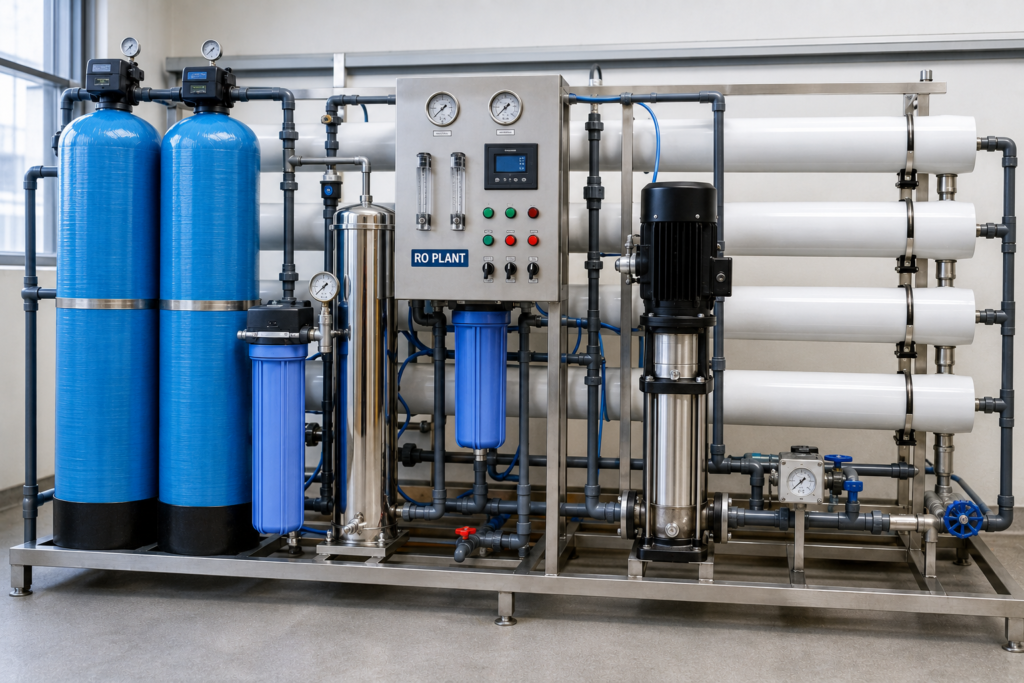
How Does an RO Plant Work?
An RO Plant generally works through several stages to improve water quality:
Pre-Treatment
Pre-treatment removes larger particles and protects the RO membrane from fouling and scaling. Depending on the raw water quality, processes such as multimedia filtration, softening, or antiscalant dosing may be used.
Sediment Filtration
Sediment filters remove suspended particles such as sand, dust, rust, and other physical impurities from the incoming water.
Activated Carbon Filtration
Activated carbon filters help reduce chlorine, organic compounds, unpleasant taste, and odor. This stage also helps protect certain RO membranes from chlorine damage.
Reverse Osmosis Process
In the RO stage, high pressure is applied to push water through a semi-permeable membrane. Dissolved salts, minerals, and many other contaminants are rejected and separated from the purified water.
Post-Treatment
Depending on the final water requirement, post-treatment may include pH adjustment, remineralization, UV treatment, or other polishing processes to achieve the required water quality.
RO Plant Applications
RO Plants are commonly used in:
- Industries
- Commercial buildings
- Hotels and restaurants
- Hospitals
- Schools and colleges
- Residential complexes
- Pharmaceutical industries
- Food and beverage industries
- Laboratories
- Manufacturing facilities
Benefits of RO Plant
- Removes dissolved salts and impurities
- Improves overall water quality
- Reduces TDS levels
- Helps remove many contaminants
- Produces purified water for specific applications
- Supports industrial water treatment
- Helps meet application-specific water quality requirements
- Can be integrated with other treatment technologies
Importance of RO Water Treatment
RO treatment is important where raw water contains high levels of dissolved solids, salts, or other contaminants that conventional filtration cannot adequately remove. Properly designed RO systems can provide consistent-quality water for a wide range of applications.
RO Plant Maintenance
Regular maintenance is important for maintaining RO system performance. It may include:
- Checking feed water quality
- Replacing pre-filters when required
- Monitoring pressure and flow
- Checking membrane performance
- Cleaning membranes when necessary
- Inspecting pumps and valves
- Monitoring treated water quality
Conclusion
A Reverse Osmosis Plant is an effective water purification solution for removing dissolved salts and many other contaminants. With proper pre-treatment, membrane selection, operation, and maintenance, an RO system can provide reliable purified water for residential, commercial, and industrial requirements.
Looking for an RO Plant Solution in Pune?
Get in touch with TMS Water Solutions for customized RO Plant solutions designed according to your raw water quality, required capacity, and specific water treatment requirements.